
Say what you will, but Thanksgiving isn’t until Thursday and the Christmas decorations have been up in the Davis home for weeks. We’re usually/always Christmas after Thanksgiving kinda people, but this year we just couldn’t help ourselves. The way the house smells sweet and spicy & how Sloan turns on the tree every morning when she wakes up & the excitement of walking through all the lit-up local shops…mmmmmm…the best.
RELATED POST: 10 Slow, Simple, No-Stress Traditions You’ll Love This Holiday Season
Whether you’re a tree before or after Thanksgiving person (I’m apparently the former now), prefer your cranberry sauce homemade or from a can (homemade all day), love or hate eggnog (OMG L-O-V-E, especially in my lattes), I think we can both agree that the holidays, no matter how you celebrate them, can throw you for a loop. Schedules get fuller, our eating habits vary *ahem* a bit, and suddenly spending money is an olympic sport. And don’t get me wrong…I’m #hereforit. But just because this season is special doesn’t mean it should sabotage your pelvic health.
As a certified pelvic rehab therapist who’s been working with patients for over 11 years now, I know the patterns and practices that can cause pelvic floor problems – and they’re EVE-RY-WHERE this time of year. You can still celebrate the holidays to your heart’s content; you can still do all things merry and bright, I’m just here to suggest you do it with a little more mindfulness this time around. Pelvic pain is no joke, and bladder, bowel, and sexual dysfunction are real killjoys, so let’s make sure none of the above are interrupting your festivities this holiday season.
If you’re finding yourself stressed
I do my best to live out the #tooblessedtobestresed mantra, but let’s be honest…I can get wound-up and worried with the best of ‘em, especially this time of year. From finding the perfect gift to fitting every festivity into an already full calendar, and don’t forget about family drama, it can be a lot. And here’s the thing – no matter what type of stressor you’re facing, the body responds the same.
If the brain senses danger or discomfort in any way, shape, or form, it will react. When those warning bells go off, the sympathetic nervous system is triggered to release cortisol and adrenaline in preparation for fight or flight. This leads to higher heart rate and blood pressure, faster and shallower breathing, suppression of the digestive and immune systems, and muscle tension (lovely…I know).
There are three main places women carry stress – the jaw, shoulders, and pelvic floor. We’ve already established that muscle tension is common during stressful seasons, and the pelvic floor absorbs a majority of that pressure. Unlike what you might’ve heard in “Women’s Heath” or “Glamour” magazines, a tight pelvic floor is not a good thing and can actually lead to pelvic pain and dysfunction.
RELATED POST: 3 [Shocking] Ways Your Pelvic Floor Responds to Stress
RELATED POST: Relax These [Other] 6 Body Parts to Release Pelvic Floor Tension
Whether it’s low grade, year round anxiety or sudden, more seasonal annoyances, stress in the (not such a coincidence) presence of new or worsening bladder or bowel issues, pelvic pain or sexual concerns mayyyyy be a sign your pelvic floor muscles have had enough. If this resonates with you, it’s vital that you work on reducing your stress (easier said than done…I know) and relaxing your pelvic floor muscles on the regular (you can grab my free guide for how to do that here).
RELATED POST: Mantras, Meditation, & 14 Other Kiiiiinda Crunchy Practices for Stress Relief
RELATED POST: My Daily Pelvic Floor Relaxation Routine & Why You Might Want to Try It Too
If you love sequins & stilettos
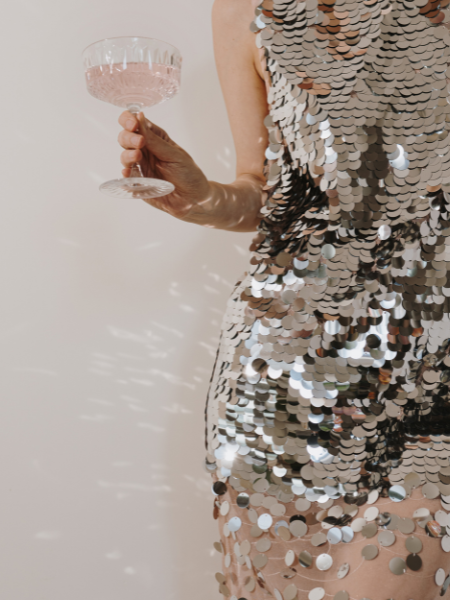
While I would live in my sweats 24/7 if I could, I also don’t mind that the holidays often come with an excuse or two to get all dolled up. Slinky and sequined dresses (sometimes on top of “shape wear”), strappy and sky-high heels – it can be beyond fun to show up and show off, but it must be known they can negatively impact the pelvic floor.
RELATED POST: 19 Reasons You Have a Tight Pelvic Floor (Plus What to Do About It)
When the abdomen is sucked in after all the buttoning, strapping, and cinching, there’s likely increased pressure around the pelvis aaaaaand the possibility that you can’t breathe properly. Because the feet and pelvic floor are neurologically connected in the brain, any shoes that create foot pain or pressure in the wrong places can affect the pelvic floor. You now know that a tight pelvic floor is not a good thing (this info will take you far in life…pinky promise) and both tight clothing and less-than-comfortable shoes can cause said pelvic floor tension.
RELATED POST: These Shoe Types May Be Sabotaging Your Pelvic Floor Health
Not willing to give these up, especially in this season of celebrations? Same girl…same. There’s nothing wrong with wanting to look your best, but I must encourage you to also prioritize *feeling* your best as much as possible. Opt for clothing and shoes that are ravishing without being restrictive. If your outfit falls in the “it hurts to be beautiful” category, be aware of how much time you’re spending in said attire. I’m all for feelin’ fancy, but ideally not at the price of our pelvic health.
If hydration is at the bottom of your to-do list
This time of year it feels so much cozier to reach for an eggnog latte or bone broth hot chocolate. I haven’t had alcohol in over two years, but this season also used to be my excuse for sipping mulled wine or spiking my hot apple cider. There’s nothing wrong with frilly and frothy drinks, but they must be balanced with good ol’ water to maintain proper hydration and ultimately pelvic health.
RELATED POST: Meet Your New Favorite [Warm & Nourishing] Morning Drink
Drinking water is one of the cheapest and most easily accessible things we can do for our health. Period. And not just pelvic health (which I’m beyond excited to get into here), but health health in general – full body, head to toe, mental, physical, and emotional wellbeing are all driven by water, and if the body isn’t well hydrated, you can expect to see the side effects.
Hydration might be the last thing on your mind while decking the halls, but it’s a check box that needs to be filled for proper bladder, bowel, and sexual function. Aim to drink half of your body weight (in pounds) in ounces of water. For example, if someone weighs 150 pounds they should shoot for 75 ounces of water per day. This goal increases to two-thirds of body weight (in pounds) for those who are pregnant, breastfeeding, living at higher altitudes or warmer climates, or exercising vigorously regularly.
When enjoying anything other than plain water, be aware that acidic foods (lemons, oranges, limes, etc.), alcohol, carbonation, sugar, and caffeine are all bladder irritants that can make bladder symptoms worse. If you notice an uptick in urinary urgency or frequency with an increase in any of the above, it may be contributing to your bladder issues. To still enjoy a #treatyoself drink, try consuming 4 ounces of water before and after to dilute and “buffer” what’s going in your bladder.
RELATED POST: Read [THIS] If Coffee Irritates Your Bladder
If you gained a few pointers here but don’t know how to apply this to your holidays, I recommend taking a day to inventory your current water-drinking habits (liiiiiiike literally write down everything you drink and how much), calculate how this compares to what you should be consuming, and start working towards that goal ten ounces at a time. Nothing motivates my personal hydration efforts like a cute new water bottle, so maybe ask Santa to slip one in your stocking this year *wink wink*.
If you cross your legs with coughing, laughing, or sneezing
Not only is this a season of a bit more sickness (boooooo), but it’s also a time of gathering with those you love most (yayyyyyyy). Aka – coughing, sneezing, and laughing are all quite customary this time of year aaaaand cause incontinence (or urine leakage) in 30% of women (or at least 30% of those who are willing to report it). Combine this frequent and sudden pressure to the pelvic floor with extra muscle tension and an escalation in those not-quite-water drinks mentioned above, and you might find yourself crossing your legs, packing extra pads in your purse, or rushing to the restroom more regularly around the holidays.
RELATED POST: Urinary Urgency & Frequency? You’ve Gotta Stop Making These 5 [Big] Bladder Mistakes
RELATED POST: 6 Common Bladder Issues (That Are Most Definitely *Not* Normal)
There’s something in our body called the “cough reflex”, and just like the reflex where your leg automatically kicks when someone taps your knee, this one involves the pelvic floor muscles reflexively contracting a split second before activities that cause increased pelvic pressure (like coughing, sneezing, and laughing) to prevent leakage. But if the pelvic floor muscles are too tight, too weak, or not coordinated enough, the “cough reflex” won’t work and urine leakage is the likely result.
RELATED POST: 5 Reasons Kegels Aren’t Working For You
RELATED POST: Strengthen Your Pelvic Floor With Zero (Yes…Zero) Kegels a Day – Here’s How
If you’re nodding along or raising your hand here, then you’ve got to try “the knack” (I don’t know why we call it that in pelvic health world…we just do?). Here’s what you do – right before doing something that normally causes incontinence, perform a strong and quick kegel (or pelvic floor contraction) and hold it through the cough, laugh, sneeze, etc., then fully relax your pelvic floor. If strong enough, this contraction will match the pressure that activity is placing on your pelvic floor and prevent leakage.
PS – Regularly practicing “the knack” can retrain the reflex and you will slowly have to think about this sequence less and less as the body starts doing it automatically. Click here for my ultimate guide to kegels that includes “the knack” and everything else you need to know for a strong, coordinated, and controlled pelvic floor.
If you’re suddenly living off of cheese and bread
I love the silent nights & twinkling lights & gift giving & tradition making, but if I had to choose only one thing to keep about the holidays, it would hands down be the food. In all honesty, the reason I throw so many parties this time of year is because I will take advantage of any and every opportunity to fill a plate with my favorite salty and cheesy finger foods. If your head & heart can relate but your gut is already grumbling just thinking about it, then keep reading, friend.
There’s nothing wrong with treating yourself this time of year, and I firmly believe it can be done responsibly with mindfulness around the quality of what you’re eating – even snacks and sweets can be nourishing when made with whole and healthy ingredients. But in those situations where you don’t have full control of the fixings or your gut just doesn’t agree with the menu, constipation can occur (and is more likely to come up in conjunction with stress, lack of hydration, and pelvic floor tension).
If you’re having less than three bowel movements per week, your stool is lumpy or hard (Type I & 2 on the Bristol Stool Form Scale) at least 25% of the time, or you have straining, the feeling of incomplete bowel emptying, the sensation of blockage or obstruction, or need to manually help stool exit the rectum at least 25% of the time, then you are constipated and need to keep this from becoming a constant. A few easy solutions to implement as needed include staying hydrated with extra electrolytes, using a squatty potty, adding a probiotic to your daily supplement regimen, and moving your body regularly.
RELATED POST: 13 [Effective] Strategies for Natural Constipation Relief
Constipation is no fun, but let’s be honest…we all find ourselves dealing with it every once in a while, maybe more so this time of year. Whether constipation is your regular or an only-when-I-eat-[blank] kinda thing, knowing what causes it and having strategies to naturally, effectively, and confidently combat it can make all the difference.
If you’re standing (or sitting) more than usual
I find the holidays usually mean we turn into one of two people – the girl who’s doing all the things for everyone else or the one who’s taking a little more time for herself to just *be*. I always intend to be the latter (buttttt am typically the former), and no matter what camp you find yourself falling in, you’re likely standing or sitting more than usual this time of year.
While neither standing or sitting are bad in themselves, there can be too much of a good thing, especially when it comes to pelvic health. Being in the same position for an extended period of time can negatively impact the pelvic floor when paired with poor posture and inadequate body awareness. Maintaining neutral pelvic posture – ribs stacked on pelvis, stacked on knees, stacked on feet – is actually quite difficult if there’s any muscle weakness or tightness in the system, but it’s where you need to be for the pelvic floor to function best.
RELATED POST: The Importance (& Power) of Posture for Pelvic Health
HOW TO FIND PELVIC NEUTRAL (IN 5 SECONDS OR LESS ;))
- Get in a comfortable sitting or standing position, even weight between your butt bones or feet, hands on your hips for a little extra feedback
- Put your pelvis in an anterior pelvic tilt as far as it will go (weight forward, butt on the back). Then put your pelvis in a posterior pelvic tilt as far as it will go (weight backwards, tail tucked).
- Continue moving your pelvis back and forth between an anterior and posterior pelvic tilt, but with smaller excursions each time. Move forward and back less & less & less until you reach the middle point between an anterior and posterior pelvic tilt.
- The hands on your hips should be parallel with the floor. Your core and glutes should feel engaged (but not tight). Your weight should be right down the center of your body.
- You’ve just found pelvic neutral. Yay!!!
- This will get easier and easier over time, requiring less back and forth until you’re able to find that magical middle called “neutral pelvic” in .00005 seconds flat. Until then, keep practicing with this technique until it feels normal and natural.
Pelvic neutral is where the pelvic floor muscles are most relaxed. It’s where the pelvic floor muscles are strongest. It’s where your body gets the best bloodflow. It’s where the surrounding muscles (like your back and hips) are happiest. Whether you’re standing in the kitchen or checkout lines for hours on end or sitting in your kids’ Christmas concert or car ride until your booty gets numb, mindfulness of your body’s alignment can go a long way. Check in regularly with the really easy, real-life-approved technique above for optimal pelvic health, no matter what position you find yourself in.
If you’re “just too busy”
You’ve likely heard the phrase, “if you want a job done, just as a busy person to do it”. And as a self-proclaimed “doer” and on-the-go kinda girl, my feelings are mixed. There’s strength, resilience, and *ahem* talent in the ability to get ‘ish done and a sense of pride and appreciation in being the go-to gal, but it’s also easy to feel burdened by errands and to-do’s, especially this time of year. And the thought of adding “improve pelvic health” to the ever-growing list borders on stressful and overwhelming.
For many, this season is an excuse to step back from self-care – diets are derailed, exercise consistency slackens, and appointments are abandoned, all under the justification of “no time”. But I’m excited to report that you don’t have to choose between hustle & health, busy & balance, work & wellbeing. We always make space for the things that matter most, and our health should fall in that category, even as women who can easily appease or procrastinate our needs with the best of ‘em.
RELATED POST: 5 [Unexpected] Benefits of Making My Pelvic Health a Priority
And when it comes to pelvic health, all it takes is a minute out of your day and a bit of mindfulness…just take a look at the things we’ve talked about in this blog post so far! Drinking enough water, checking in with your posture, “the knack”, and relaxing your pelvic floor (have you downloaded my free guide on how to do that yet!?) are strategies I solemnly swear everyone has time for.
RELATED POST: How to Make Time For Your Health Among the Hustle
RELATED POST: Easy & Impactful Ways to Use Your Time Confetti to Improve Your Pelvic Health
RELATED POST: 10 Pelvic Health Shortcuts That Make a BIG Difference (…and Quickly!)
I preach a “less is more” approach to pelvic health for [this] very reason – I want these tips & tricks & techniques to fit seamlessly into your days (no matter the season). Time for self-care can’t be found; it won’t suddenly waltz its long-lost self through the front door. It needs to be intentionally created and fiercely claimed with zero qualms and full confidence. My hope is that the information here helps guide where you put that time.
You can have pelvic health &&& enjoy your holidays too
As you head into this holiday season, please remember that protecting your pelvic health doesn’t mean missing out on the magic. You don’t have to trade charcuterie for carrot chips or swap your sparkly dress for sweatpants (though if you want to…no judgement here). It just means showing up with mindfulness, intention, and kindness towards your body, maybe even more so this time of year.
You deserve to socialize without sneezing interrupting the celebration. You deserve to have fun with every festivity without constipation or pelvic pain making you feel frustrated. You deserve to ring in the new year feeling clear, confident, and in control of your body. And the best part? All of that is 10000000% possible with just a few simple shifts that take less time than wrapping a present.
So put up that tree whenever you want, add the eggnog to your latte, and wear those heels to the holiday party. Just remember to drink your water, check in with your posture, and give your pelvic floor a little TLC along the way. The best gift you can give yourself this season is a body you can trust a pelvic floor that doesn’t hold you back from all things merry & bright.
-Amanda
Disclaimer: The content provided here does not constitute medical advice, nor is it a substitute for personalized healthcare. I’m a doctor, but I’m not your doctor. If you have concerns about a medical condition, diagnosis, or treatment, you should consult with a licensed healthcare professional.
Disclosure: Some of the links above are affiliate links, meaning, at no additional cost to you, I will earn a commission if you click through and make a purchase. No pressure, but I have a feeling you’re gonna like what I’ve taken the time to put my recommendation behind.


