
As a pelvic floor physical therapist, I have #noshame sharing the disclaimer that I know a lot about a little bit when it comes to the human body. You wanna talk about bladder, bowel, and sexual anatomy & function? I’m your girl! The musculoskeletal system in general? Also one of my strong suits! But everything else? Let’s just say I might know more than your average bear but will liiiiiiikely have to refer to Google a time or ten. So full disclosure right up front – oral health is not my specialty.
And while I’m not crazy enough to think *everything* is related to the pelvic floor, science has shown time and time again that our bodies are not just isolated parts working independently, but instead incredibly interconnected systems…and the link between oral and pelvic health is no exception.
The crazy connection(s) between the mouth & vagina
Think of the body as one continuous ecosystem. The mouth and vagina might seem like they’re on totally opposite ends of our trunk (and let’s be honest…they are!), but what goes in must come out, and this is primarily through the digestive and urogenital tracts. These systems aren’t just physically linked, they share similar environments and can influence each other in multiple ways.
In the womb, our bodies start out as a small, simple tube with the future mouth and pelvic openings right next to each other. During embryonic development, this tube elongates, folds, and differentiates into and through our complex body systems. And while this ultimately creates distance between the two structures, the original connections are still there, still related, just stretched out.
Both the mouth and vagina are lined with mucous membranes, a type of tissue that’s both protective and absorptive. Each membrane has various microorganisms and a unique microbiome that can affect and interact with each other, meaning bacteria, inflammation, and immune responses can travel from the mouth to the vagina, and visa versa. This is why conditions such as lichens planus and candida (or yeast) infections can present with symptoms in both areas.
A pelvic rehab therapist’s take on holistic oral health
Again…not claiming to be a dentist over here (*waves arms wildly*), but if a patient comes to me with a chronically inflamed, irritated, or infected vulva or vagina, not only do I encourage them to talk to their doctor (if they haven’t already), but I also take the time to educate them on proper vulvar care, how to relax their pelvic floor, aaaaaand oral health.
RELATED POST: The 411 on Pubic Hair & Your Ultimate Guide to Care for “Down There”
My holistic approach to health assumes that what we put in, on, and around our bodies can make a big difference, both positively and negatively, and that applies to the mouth, and therefore, the vagina too. Because many of us perform our oral care routines at least once a day (hopefully twice…and maybe even more!), a few simple tweaks can have a not-so-subtle impression on our overall wellbeing.
TONGUE SCRAPING
The tongue hosts microbes and bacteria that migrate up and down from the digestive tract overnight, and tongue scraping first thing in the morning and at night before brushing removes that coating from the tongue’s surface and decreases said migration. I grab my copper tongue scraper (copper is naturally antibacterial) and run it over my tongue from back to front 2-3 times before flossing & brushing & even my morning cup of coffee. It’s not only improved how my mouth looks and feels, but also promotes balanced oral (& gut & vaginal) bacteria, fresher breath, heightened taste, and better digestion. All of that from a $7 tool and a few seconds a day?!? Sign me up!
FLOSSING
I once had a dentist tell me that if he had to choose between brushing & flossing every day, flossing would be his mouth-cleaning method of choice, and it’s from that moment on that I vowed to be an adult and make flossing a regular part of my oral health routine. I aim to use floss that’s unflavored (that “minty freshness” is likely made from chemicals), un-waxed (also chemicals), and biodegradable, and these floss picks have been my go-to for years. I’ve also been looking into trying a water flosser and this is the one I have my eye on.
Flossing before brushing is preferred as it removes food particles, debris, and bacteria from between teeth and creates a cleaner, more reachable surface for a tooth brush. Use the floss to not only get between the teeth but also to clean each side of the tooth with a gentle up-and-down motion into the gum line. My goal is to always floss at least once a day (in the morning), but I’ve recently started adding it to my nighttime routine as well.
BRUSHING
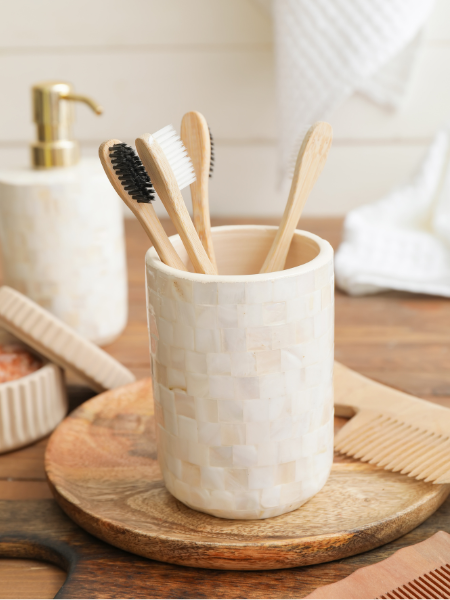
Brushing daily is basic oral health…I mean, even my four year old knows this! But the timing and technique and types of tools we use can make or break this regular wellness ritual. Whether you use an electric toothbrush or go the ol’ manual toothbrush route, I look for soft bristles with no added color that wears off as you brush (there’s those sneaky chemicals again!). Ideally you would use a dry manual toothbrush to remove plaque first then an electric toothbrush with toothpaste to polish. There are more and more healthy options for toothpaste out there, and while I’ve tried and liked Risewell, Boka, & Nelson Naturals (paste options) and Vanman’s & Living Libations (powder options), I’m currently enjoying making my own bentonite clay toothpaste using this recipe.
Now let’s talk timing, because WHEN you brush can be a matter of helping or hurting you. Many of us (myself included) have routinely waited until after our morning coffee and breakfast to brush our teeth, but the bacteria that builds up on the teeth overnight feeds off food and produces acid that erodes away the tooth’s enamel. Brushing first thing in the AM (yes…before your coffee & breakfast!) removes this bacteria, protects the teeth, and stimulates saliva production, all of which will enhance your morning dental care efforts.
ORAL PROBIOTICS
After my first miscarriage I started experiencing fairly significant tooth pain and sensitivity. My dentist recommended an oral probiotic, and adding this to my daily oral hygiene regimen has almost fully resolved my dental discomfort. When identifying a “good” oral probiotic, I look for one that has strains of M18 and BLIS K12, both of which promote a healthy mouth microbiome. Adding this after tongue scraping, flossing, and brushing (in that specific order) has helped my teeth and mouth feel so much healthier.
RELATED POST: My Real & Raw (& Random) Thoughts After Miscarriage
OIL PULLING
The first time I heard about oil pulling it was a hard pass, and the first time I tried it I almost gagged. But adding this practice to my holistic oral health routine once to twice a week has helped my teeth look and feel better than ever before. When I do this, it’s at night before brushing. I put a teaspoon of quality coconut oil (from a glass jar is best) and a drop of tooth serum in my mouth and swish it over my gums and through my teeth until it turns completely watery, then spit out into a trash can (not the sink!) and proceed with brushing. This helps reduce and promote “bad” and “good” bacteria respectively, remove plaque, and freshen breath.
MOUTH TAPING
There’s more and more info out there on the downsides of mouth breathing, specifically at night when mayyyyyybe you’re not totally aware of or in control of it happening. Excess airflow through the mouth for hours on end inhibits saliva production, alters normal breathing patterns, and can cause everything from oral health problems (like gum inflammation & cavities) to sleep issues, respiratory concerns, hindered blood & body oxygenation, headaches, digestive troubles, increased risk of infection, plus poor facial & dental development in kids. While it can be worth exploring the root cause of mouth breathing such as medications, food allergies, or sinus health, training the airways with mouth tape at night is an accessible and effective option.
What I *don’t* use for holistic oral health
My “less is more” approach to health means a few things – that I believe small and simple strategies done correctly can make a big difference and often the fewer steps, ingredients, or processing something has the better. While some of my holistic oral health efforts might seem “extra” or make some people’s eyes roll, there are a lot of things I’ve eliminated from my routine that have made just as much of a difference. If you don’t have the ability to add to your dental care today, consider subtracting the following things with intention over time.
Toothbrushes with colored bristles. Apparently there are two main reasons for that bit of color on toothbrush bristles – to demonstrate how much toothpaste to use and indicate when it’s time to get a new toothbrush…and it’s the latter of those two that bothers me more. Like, where does all that color go??!? In my body is where! And while that may seem like a small thing, brushing twice a day for our entire lives adds up. Both the manual and electric toothbrush options I listed above have plain colored bristles with no added coloring.
Mouthwash. Most conventional mouthwashes you find at the grocery store are full of alcohols and dyes that completely destroy the mouth’s microbiome. There are even studies that show an association between mouthwash use and oral, head, neck, and esophageal cancer. While there are some natural mouthwash alternatives out there if you just can’t give it up (this was the best I could find), I’ve personally decided to forego this step and do oil pulling instead.
Flavored floss. Sure that minty freshness can *feel* nice, but let’s be honest…it doesn’t actually do anything for your oral health. Nine times outta ten added “flavor” or “aroma” just means added chemicals, and choosing plain ol’ unflavored floss like these picks provides the same tooth and gum cleaning benefits but in a much safer way.
Teeth whitening strips. We’ve all seen our favorite IG influencers selling “safe” and “all-natural” teeth whitening products, and some of them do seem overall “healthy”…butttttttt I just can’t bring myself to do it. Discolored teeth is from one of two things – the inner pulp chamber of the tooth is lacking nutrients (fat soluble vitamins, specifically D3 and K2) causing the tooth to change color beneath transparent enamel or because pigmented foods are staining the plaque build-up on teeth. So instead of commercial teeth-whitening products, I take this supplement and brush equal parts aluminum-free baking soda and high quality sea salt and on my teeth for a few minutes 2-3 times a week.
Fluoride. Welp…call me controversial, but my research into fluoride has me steering clear of it as much as possible. I forego fluoride at the dentist for myself and my daughter, only purchase fluoride-free oral health products, and drink filtered water as much as possible. For me the cons outweigh the pros and it’s a “better safe than sorry” kinda thing. Thankfully nowadays there are so many great products out there without fluoride that it’s overall an easy switch.
The jaw & pelvic floor relationship
I’ve already mentioned this but I think it bears repeating – as a baby forms in its mother’s womb, one of the first things that develops is called the dural tube, a fibrous connective structure that runs from the skull to the pelvis. The tissue ultimately attaches the mouth to the bowel and bladder systems and creates the spinal connection from the head to the tailbone (aka jaw and pelvic floor muscles). This is why when we talk in a low tone, the pelvic floor lengthens, and a high tone causes the pelvic floor to contract.
As humans living in this modern world we tend to be stressed, and two of the primary places we carry said stress are the jaw and pelvic floor. Stress, along with other things like posture, medications, trauma, chronic pain, breathing patterns, depression & anxiety can cause tension in the jaw muscles or the pelvic floor. And because of their fascial connection, it’s common to see tightness and even pain in both places.
RELATED POST: 19 Reasons You Have a Tight Pelvic Floor (Plus…What To Do About It)
RELATED POST: 3 [Shocking] Ways Your Pelvic Floor Responds to Stress
RELATED POST: The Importance (& Power) of Posture for Pelvic Health
In my pelvic health clinic, I find that most women’s bladder leakage, urgency, and frequency, pelvic pain, and constipation (to name a few) are aaaaaaalmost always due to tight pelvic floor muscles. Once I teach them how to relax their pelvic floor (you can grab my FREE, 4-step guide on how to do [that] here), many of their symptoms resolve before we’ve done a single kegel or core exercise.
RELATED POST: My Daily Pelvic Floor Relaxation Routine & Why You Might Want to Try It Too
RELATED POST: Relax These [Other] 6 Body Parts to Release Pelvic Floor Tension
Similarly, it can also be beneficial to decrease strain on the jaw muscles, especially if you have jaw pain, TMJ/TMD issues, teeth clenching or grinding, and tension headaches. While it’s actually quite easy to stretch & massage your jaw with your hands, I also like using my Primally Pure gua sha stone and facial cups with the plumping serum (use code DRDAVIS to save 10% on all things Primally Pure) to break up fascia adhesions, increase lymphatic and blood flow to the face, and improve my skin health and appearance in the process.
When you’re aware of this relationship between the jaw and pelvic floor, one can tell you a lot of information about the other – both in the moment (if one’s clenched, the other probably is too) and overall (if one’s painful or dysfunctional, the other one might be too). There are physical therapists that specialize in both the jaw and pelvic floor…I just so happen to be the latter *wink wink* and am here to help with everything from that free guide on how to relax your pelvic floor muscles to a personalized pelvic health consultation.
My favorite resources for oral health
I’m a multi-passionate person in life and extend that same nothing’s-off-the-table philosophy to my learning as well. When I find a topic that will contribute to my and my family’s wellbeing, I dive on in. And because oral health is connected to my passion for and profession in pelvic health, this was an easy rabbit hole to go down. If you’d also like to learn more on the topic (from people who are far more knowledgeable than me), these resources are a great place to start.
This Instagram follow. I don’t spend try not to spend too much time on social media these days, but when I am scrolling I want what I see to do nothing but benefit my head, heart, and health. When it comes to oral health for kids and adults, airway expert and functional dentist Dr. Molly is a must-follow. Not only does she seem like someone I’d want to be friends with (& knowing the oral and pelvic connection, I totally think we’d be BFF’s :)), but I’ve implemented and seen success with many of her teachings in both my and my daughter’s dental habits.
This blog post. I loooooove a beefy blog post that holistically dives deep into a topic, and I can’t stop going back to this one for all things dental care. From how to eat to support oral health to naturally healing cavities and 20 (yes, 20!) simple tips to uplevel tooth & mouth hygiene…it’s all here and definitely worth pinning, saving, or bookmarking.
This book. Again, not a dentist, but from what I can gather Nadine Artemis is a pretty big name in the toxin-free dental health world. And it’s no surprise because her book “Holistic Dental Care” is pure. freakin’. gold. While there’s almost always a time & place to seek help from a specialist, I also firmly believe in advocating and taking action for your own health, and this book’s promotion of “self-dentistry” with holistic but realistic at-home strategies is one everyone should have on their bookshelf.
This podcast. Once I read Nadine Artemis’ book (see juuuuust above this), I wanted to hear more from this ridiculously knowledgeable woman and sought out other forms of media that she was on. The “Rewild Yourself” Podcast by Daniel Vitalis has had Nadine as a guest multiple times, but this oldie-but-goodie episode from 2016 was by far my favorite. If you don’t have the bandwidth to dive into her book right now, this hour(ish)-long conversation is your next best option.
Again, I’m not a dentist, but…
While the main topics of discussion in my pelvic health clinic are bladder leakage, pain with sex, constipation, and postpartum healing, you miiiiiiight be surprised to hear that oral health comes up in the conversation almost weekly. And because I get most of my inspiration for blog post topics from my patients, it was finally time to create this resource.
I will say it until I’m blue in the face – I AM NOT A DENTIST (*still waving arms wildly over here*)! But I am obsessed with holistic & realistic health from the pelvic floor up and ^^this^^ is my take on dental care with a subtle pelvic health spin. Everything in the body really is connected, and because everything that gives us life (food, water, and air) enters through the mouth, every system down the chain relies on optimal oral health.
Even if you don’t agree with some of the things you see here, my sincere hope is that it at least gets you thinking about how you’re prioritizing your oral health, the tools you’re using to do so, and what techniques you easily can add (or subtract ;)) to get one step closer to a healthier Y-O-U.
– Amanda
Disclaimer: The content provided here does not constitute medical advice, nor is it a substitute for personalized healthcare. I’m a doctor, but I’m not your doctor. If you have concerns about a medical condition, diagnosis, or treatment, you should consult with a licensed healthcare professional.
Disclosure: Some of the links above are affiliate links, meaning, at no additional cost to you, I will earn a commission if you click through and make a purchase. No pressure, but I have a feeling you’re gonna like what I’ve taken the time to put my recommendation behind.


